8

I'm using a Samsung 700T tablet/convertible (basicallly, the Samsung equivalent of the Microsoft Surface Pro.) It runs Windows 8.1 This comes with a dual-core ULV CPU, 4 GB of RAM (which is too little!) and 128 GB SSD.

This computer occasionally gets very sluggish, pausing for 10-30 seconds before responding to clicks. It feels as if the computer is paging in memory, but I'm not quite out (3.1 GB utilization out of 3.9 GB) However, when this happens, performance monitor shows that average disk response time is in many-seconds.

With an SSD, how can that happen? I'm supposed to get 10000 ops/s through that interface, right? No heavy mechanics involved.

See this screen shot for what this is:
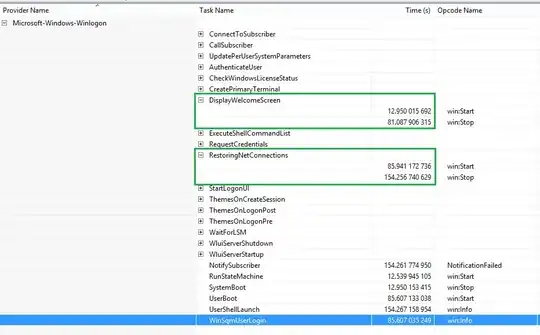
Task Manager showing performance graph and 9058ms response time for the C drive

The second question is: How can I fix this? (If at all.)

Jason Aller
  • 2,340
  • 6
  • 23
  • 21
Jon Watte
  • 825
  • 2
  • 10
  • 16
  • First step would be to identify what is causing the high disk usage. – Gizmo Apr 30 '14 at 18:06
  • If your serious about getting to the bottom of this then the built-in Windows Performance Monitor will tell you everything you need to know. Caution: it is a little bit advanced but nothing that some Googling won't cure. – MonkeyZeus Apr 30 '14 at 18:50
  • This doesn't answer the question: If a task had to wait 9 seconds between issuing some I/O, and the disk can do 10,000 I/O requests per second, that means there are 90,000 other I/O requests ahead of this one. It seems unlikely that software would be written to have that request rate, because that wouldn't work at all on spinny disks. So, perhaps there's something wrong with the SSD, or the system, that causes artificial request rates or artificial latency? The main user of I/O is likely the background backup tool I use (CrashPlan.) But that shouldn't block all other I/O. – Jon Watte Apr 30 '14 at 19:08
  • Peak I/O requests is just that; it doesn't account for the average time of each request. You could easily have a near-full disk that's being asked for data that's spread across many blocks, due to a high amount of stale pages. Each I/O request for X bytes is now retrieving far far more than X bytes. Plus there's a garbage-collection overhead. This alone doesn't justify the numbers you're seeing though. – RJFalconer May 05 '15 at 16:12
  • How much free space do you have on your drive, and how big is the windows pagefile? – RJFalconer May 05 '15 at 16:14
  • It seems like SSD is not alive. – BDRSuite Jun 12 '15 at 14:14
  • And is the SSD encrypted? Also, to agree with what others mentioned, maximum IOPS under perfect conditions != actual IOPS you get in heavy use. You also cannot normally queue more than 32 requests on S/ATA devices anyway. – qasdfdsaq Jun 12 '15 at 14:52

5 Answers5

5

Your SSD seems to be used 100%, causing the high answer time and definitely also wearing it off. There has to be a process causing this, e.g. an antivirus solution meaning it too well. Fastest way to determine what's wrong should be to simply look up which application it is. While the perfomance monitor Windows 8 delivers is pretty powerfull, you should really try ProcExplorer

Run it with elevated rights, right-click any column, select columns and view the I/O:

Example columns

As soon as you know which application it is, come back and we'll try to find a way to stop this.

Patrick R.
  • 1,311
  • 1
  • 11
  • 24
  • As I said above, I don't *think* that this is a software problem. Assuming I/O queuing is roughly FIFO, what would enqueue 90,000 requests in parallel? It's more likely to me that this is a system-software/driver or hardware failure of some sort. – Jon Watte May 01 '14 at 18:12
3

I had this happen on Windows 10. I uninstalled the Intel SATA controller in device manager (requiring a lot of patience, given the slow response).

Before rebooting, also open regedit and re-enable the storahci service (HKEY_LOCAL_MACHINE\SYSTEM\CurrentControlSet\Services\storahci\StartOverride -- set to 0), otherwise your machine won't boot (INACCESSIBLE_BOOT_DEVICE). If you forget, you can start up in safe mode and do it

Mark Sowul
  • 3,042
  • 19
  • 22
0

Open Computer Management (right-click on "This PC" and select "Manage", or type compmgmt.msc at a Run prompt) In the left pane, expand Xystem Tools | Event Viewer | Windows Logs | System. Look for "warning" or "error" messages with "Disk" as the Source. I'll bet you're getting a bunch.

btw, if your SSD is in any sort of hot-swap tray or caddy, get rid of that. IME, most of them are not what I'd call enterprise-grade hardware. A simple cable from the motherboard to the SSD (or HD for that matter).

Jamie Hanrahan
  • 23,140
  • 6
  • 63
  • 92
0

The ope/s are best case scenario, so don't bank on 90000 in the q. That said... the picture looks like there's an issue with the SSD. The read/write levels are too low for that response time. I had a similar issue with an OCZ drive and an intel controller, where when the drive was sent to sleep it didn't properly wake up, or took a large number of seconds to wake up. The solution for me was to no longer put the hard drives to sleep, and it worked a charm on a pc that was always plugged in. Not sure how that will play out on a tablet though!

Carl
  • 109
  • 3
-4

If it persistently stays at 100 percent, then your SSD is failing.

I once had a computer with a hard disk that did so. I removed the other HDDs, DVD drives, etc but I still had the same 100 percent problem. I then took it out of my computer and suddenly, disk usage was only 25 percent. I later realized that the case was not big enough to hold my 3.5 HDD and it was being squeezed. If this is your problem, get yourself a new case.

Also, make sure your SSD drive is perfectly horizontal

Cfinley
  • 1,435
  • 3
  • 14
  • 20
  • 10
    The orientation of the SSD has no effect on the drive, as there are no moving parts. Unless your 3.5 HDD was in the wrong slot, it shouldn't have been squeezed. – Cfinley May 05 '15 at 14:59