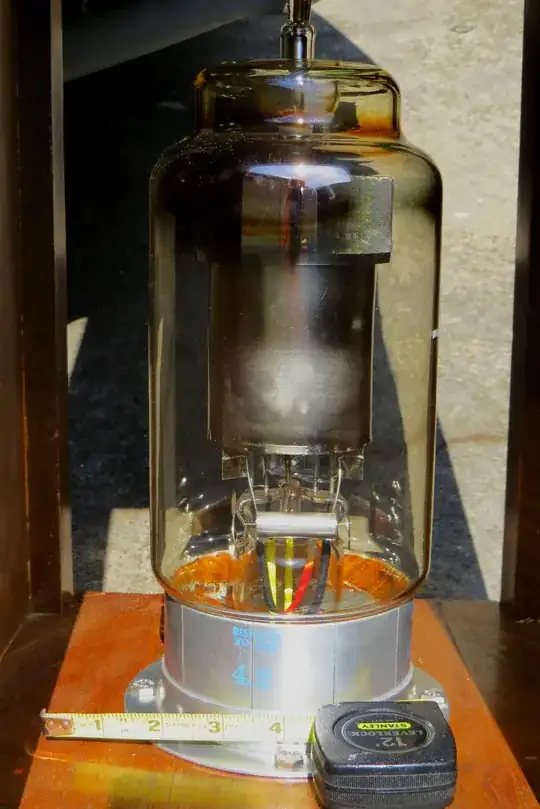
I recently bought this tube for use in an art project and would like to know what it is and what it was originally used for. Unfortunately, the silkscreen labelling on the glass envelope was worn off and unreadable and there are no other obvious identifying marks on it. The tape measure indicates scale (it's big!). I'd also like to find a source for more like this, since it has generated a lot of interest sitting on the shelf in my shop.
Asked
Active
Viewed 508 times
8

Sumithran
- 573
- 5
- 23

niels nielsen
- 897
- 5
- 12
-
2Wait -- *insulated* color-coded wire on the feed-ins? Might be an instructional demo that doesn't actually amplify (or has a very conventional tube hidden inside so the demo can be live). – Zeiss Ikon May 31 '19 at 11:20
-
Are there any markings? I see "4816" on one of the inside metal pieces. It looks like there is some white lettering on the right side of the glass that could be useful. – Chris K8NVH May 31 '19 at 16:59
-
Those black, red, and yellow wires could be from a computer power supply cable. If so, that dates the tube (or its base modification) to ~1990--present. – Mike Waters May 31 '19 at 17:32
2 Answers
6
This looks like a JAN-CTL-5948A, found via images within the search results for "huge vacuum tube".
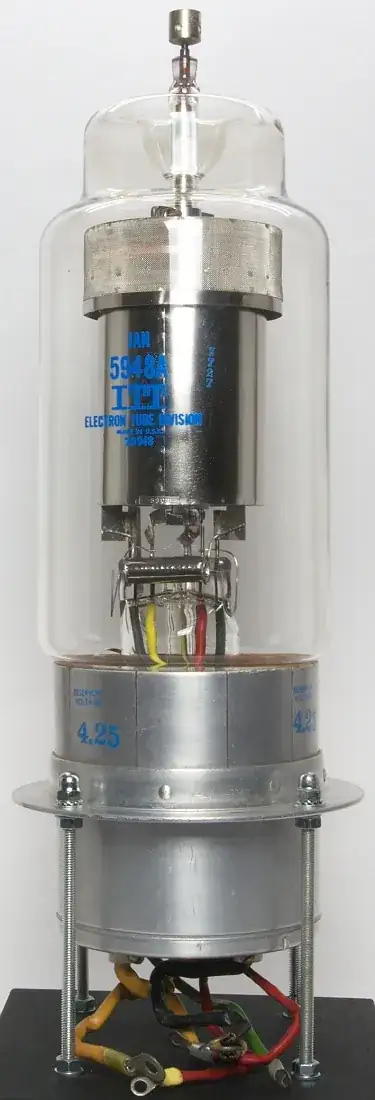
According to the linked site (from which the picture is also taken):
The primary application of this tube is in high power, high voltage radar modulators. The 5948A is capable of supplying 12 megawatt pulses in this service.
The datasheet indicates that it's a bit beyond a typical vacuum tube:
The special features of the 5948A include an internal hydrogen-reservoir capable of producing a wide range of hydrogen pressure […]
Some online listings title this as a "Industrial High Power Early Warning Radar Military Hydrogen Thyratron Tube". I couldn't recommend trying to get it working ;-)

natevw - AF7TB
- 7,219
- 2
- 23
- 58
-
Excellent, Nate! Anyone know whether it might it have any potential amateur radio applications? That being said, radar is illegal on the ham bands. – Mike Waters May 31 '19 at 20:34
-
@MikeWaters isn't *experimental* RF usage, including radar, OK, in some form? – Marcus Müller Jun 01 '19 at 07:49
-
1@hobbs-KC2G but it *is* a thyratron, not an amplifying tube; meaning that it's not designed for continuous, but pulsed operation. I must admit that "being able to dump a lot of current for a short time" isn't exactly what I'd be looking for in many applications, especially since, as gigantic as that thing is, its pulse duration with > 1.25 µs isn't really all that short (roughly equivalent to 8 MHz of bandwidth, which is practically nothing for modern radars). – Marcus Müller Jun 01 '19 at 07:59
-
… and that it's "cooldown" period only allows for maybe 1500 pulses a second. In other words: can't even use it for fast on-off-keying sensibly. If I use 8 MHz to transport 1.5 kbd of on-off-keying, someone will hopefully be angry with me. At the same time, if I *have* these 8 MHz of bandwidth, and only need to be at least that good in data rate, I can have a spreading factor of more than 5330 – about 37 dB of processing gain, meaning that a 37 dB lower averager-power transmitter system performs just as well. And that's a lot easier to build! – Marcus Müller Jun 01 '19 at 08:11
-
@MarcusMüller Under FCC rules, pulse/radar transmissions are *verboten* **on HF**. Are they permitted in Germany or other countries? The short pulses consume very wide bandwidths. – Mike Waters Jun 02 '19 at 23:28
-
Looking at the datasheet a little closer, I seriously doubt that it could be used in any other mode except for pulse. – Mike Waters Jun 02 '19 at 23:37
-
1@MikeWaters my understanding was that yes, staying in the designated bands and adhering to the cooperation rules and the identification necessity, amateur radio licenses can be used for the purpose of experimenting with radio technology, even if not for the purpose of communication. – Marcus Müller Jun 03 '19 at 05:31
-
@MikeWaters that question is important enough to [be asked on its own](https://ham.stackexchange.com/questions/14650/can-i-use-a-amateur-license-to-experiment-with-radar) – Marcus Müller Jun 03 '19 at 05:39
-
@MarcusMüller It turns out that the [FCC does allow pulse transmissions above 33 cm](https://www.ecfr.gov/cgi-bin/text-idx?c=ecfr&SID=336ab7469b61ecbfa15086dbf1bf2c59&rgn=div5&view=text&node=47:5.0.1.1.6&idno=47#se47.5.97_1113). I found nothing prohibiting radar. Having said that, it is very unlikely that this tube would operate there. – Mike Waters Jun 03 '19 at 17:39
2
If the diameter of the glass base (just above the metal mounting bracket) is approx 5 ", its a type 5948 or 5948A, If the diameter o the glass base( just above the metal mounting ring) is apprx 7", its a type 1247. Both tubes are pulse modulators for radar with built in hydrogen replenishment.So they are nothing more than a high power switch. The 5948 will switch 12 Mw and the 1247 will switch 30Mw. Certainly the latter will generate x-rays with 30KV on the plate. They are of no use in amateur service. The filament of the 1247 takes 5V @40amps.pretty costly transformer for playing. I can tell you the filament is highly shielded and you can't see it when the filamen is lit. Technical specs for the 1247 are contained in the February 1953 edition of "Electronics"magazine.

Ralph Cameron
- 21
- 1
-
-
thanks Ralph! I'm using the tube in an art project, backlit with a string of orange LED's so the "filament" is visible! – niels nielsen Jun 21 '20 at 03:34