3

So I've been looking at the internals of the Icom AT-141 end-fed antenna tuner which I have, and I've noticed that it has some sort of pre-tuning LC stage before its traditional L-tuner network.
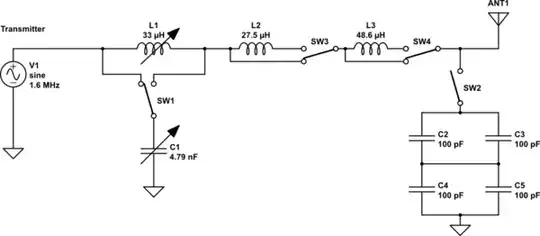
schematic

simulate this circuit – Schematic created using CircuitLab

The arrows on the left side of the schematic are supposed to represent tunable components (in reality, series of relay-switched fixed components).
The C1 has range from 9 pF to 4.79 nF, and I estimate that the L1 has range from 56 nH up to 33 μH.
On the right side, I've estimated the coil inductivities, since they're not listed in the documentation, and the capacitor capacitance is correct. For extra context, the tuner is designed to tune a wire at least 7 meters long across range starting from 1.6 MHz and going up to 30 MHz.

So my questions are:
Is there a commonly used name for this tuner topology, and In what way would this topology be more advantageous compared to just a classic L-match tuner with more component values in its L and C stages?

AndrejaKo
  • 2,853
  • 2
  • 17
  • 31
  • Is that topology a Z-match ? Just learning about them. – wbg Feb 22 '22 at 19:49
  • 1
    @wbg I don't think that it is. We don't have the transformer between the radio and the antenna Instead, all of the coils are connected in series, or are out of circuit. – AndrejaKo Feb 22 '22 at 20:01
  • I didn't want to write this in my answer, because it would have sounded a bit unkind, so let's comment here: I mean, knowing you are rather skilled, Andreja, well, what's circuit names but smoke and thoughts, lost in the rain: every implementation is a bit different, and whilst it's good for understanding when you can look at things and say "hah! a Pi match!", when it's more complicated/combined, you'd always just go back and calculate the frequency behaviour of the circuit, by hand or SPICE. I guess the old "dead tree" learning material couldn't know this would become so easy one day! – Marcus Müller Feb 26 '22 at 10:43

1 Answers1

3

First of, let's simplify. C2-C5 form just one 100 pF capacitor "Cv" (probably with higher voltage rating), and we can just say "L2+L3 and bypasses make one L, which is either open or has a value between 27.5 and 76.1 µHJ; let's call it Lx".

I'd say this has multiple operation modes:

  • SW1 left, SW2 closed: $\Pi$ match (L1-Lx, if not bypassed, simply form one L, C before and after to ground; a $\Pi$ matcher)
  • SW1 right, Lx bypassed, SW2 open: L1 and C1 form a low-pass filter, and based on the values, I'd say this is an L matcher
  • SW1 right, Lx bypassed, SW2 closed: C1 and Cv form one capacitor, call it Ct, and then we L1 and Ct form a low-pass filter, an L match.
  • SW1 right, Lx not completely bypassed, SW2 closed: yeah, some ladder filter.
Marcus Müller
  • 15,225
  • 22
  • 44