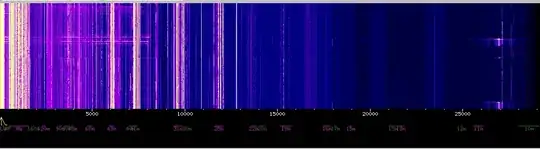
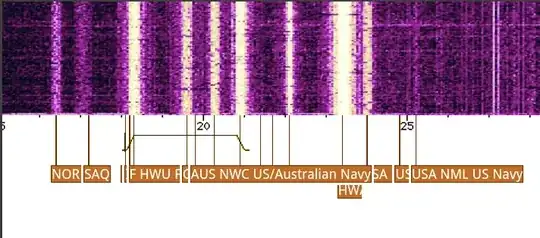
I want to add to Phils answer. The VLF around 3-30 kHz are used for submarine communication. From WikiPedia:
VLF radio waves (3–30 kHz) can penetrate seawater to a depth of approximately 20 meters. Hence a submarine at shallow depth can use these frequencies. A vessel more deeply submerged might use a buoy equipped with an antenna on a long cable. The buoy rises to a few meters below the surface, and may be small enough to remain undetected by enemy sonar / radar.
...
Because of the narrow bandwidth of this band, VLF radio signals cannot carry audio (voice), and only transmit text messages at a slow data rate. VLF data transmission rates are around 300 bits/s – or about 35 eight-bit ASCII characters per second (or the equivalent of a sentence every two seconds) – a total of 450 words per minute. Simply shifting to 7-bit ASCII increases the number of transmitted characters per time unit by 14%. An additional shift to a 6-bit or a 5-bit code (such as the baudot code) would result in speeds of more than 600 and 700 words per minute.
Other signals around 200 kHz may be differential GPS or other radio navigation functions:
In parts of the world where there is no longwave broadcasting service, Non-directional beacons (NDB) used for aero-navigation operate on 190–300 kHz (and beyond into the MW band). In Europe, Asia and Africa, the NDB allocation starts on 283.5 kHz. The LORAN-C radio navigation system operates on 100 kHz... Differential GPS telemetry transmitters operate between 283.5 and 325 kHz. The commercial "Datatrak" radio navigation system operates on a number of frequencies, varying by country, between 120 and 148 kHz.