I'm a bit confused about what a single-chip microcomputer is. Specifically, what is the difference between a single-chip microcomputer and a multi-chip microcomputer? (Since chip is so informal, what exactly does it refer to?)
Asked
Active
Viewed 2.1k times

2 Answers
20
Here are the main differences:
Single Chip
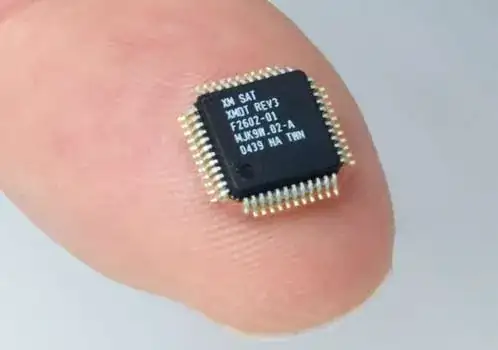
- Everything is packaged in the same single physical IC
- The IC contains the CPU core(s)
- The IC contains the memory (ROM and RAM)
- The IC contains all the IO hardware (Video, serial, etc)
Single-chip computers are mainly of the form known as Microcontroller chips (the most commonly known are the PIC range by Microchip inc) and used in embedded devices. They provide much more basic functionality but are far simpler to work with as they don't require any external chips in order to function. Some attempts have been made to create single-chip computers of the style of Intel or AMD PC architectures, but due to the complexity of the components involved this has not been a very easy task. Again, these are generally used in low-end embedded systems, such as touch-pad devices and industrial control systems.
Multi-chip
- The CPU IC contains the CPU cores.
- The Video GPU contains the video processor.
- The RAM modules contain the RAM memory.
- The BIOS chip contains the ROM memory.
- The "chipset" (northbridge/southbridge, etc) contains the IO logic and bus interface logic
Traditional computers are Multi-Chip. Some of the most recent processors (some of the i series from Intel) include the video GPU in the processor IC, but they still require external chips in order to interface with the rest of the computer (PCI bridge, etc)


-
Upvoted, though there's a small factual error IMO. PIC chips are microprocessors, not microcomputers. – Journeyman Geek May 01 '11 at 09:08
-
@Journeyman A microcomputer is a CPU with ROM/RAM and interfaces, yes? Isn't that what a PIC chip is, but just on a smaller scale? agreed it's not a PC, but it's still a single-chip computer. It has everything in the chip that defines a computer. – Majenko May 01 '11 at 09:11
-
well, i think the archaic term microcomputer is the dividing line - http://en.wikipedia.org/wiki/Microcontroller - microcontrollers are embedded systems, while microprocessors/SOCs are general purpose systems - which 'microcomputers' are. – Journeyman Geek May 01 '11 at 09:15
-
@Journeyman IMHO the microprocessor is one individual component of all these systems. The SOC, the microcomputer and the PIC all contain a microprocessor (of one size or another - admittedly the PIC microprocessor is generally only 14 bit and only a handful of instructions), but it is a distinct component within the architecture. – Majenko May 01 '11 at 09:20
-
1The term `microcomputer` was coined at a time in the early 80s when a *real* computer, a mainframe, filled a whole room. The idea was to emphasise its small size. – pavium May 01 '11 at 10:03
-
They should be called nano-computers now as most CPUs use nano-meter technology – Majenko May 01 '11 at 10:24
-
I highly object to the use of `PIC chips`. PIC is just one line of microcontrollers made by Microchip Technology Inc. There are numerous other manufacturers of similar products such s Texas Instruments, Atmel, Renesas, Intel, Toshiba and so on. – AndrejaKo May 01 '11 at 10:29
-
@AndrejaKo Agreed - I have re-worded that bit – Majenko May 01 '11 at 10:36
-
1Micro was in contrast with mini and has nothing to do with process size used in components - [mini computers](http://en.wikipedia.org/wiki/Minicomputer) were smaller than mainframes and larger than PC/microcomputers . Practically speaking a smartphone COULD perhaps be considered a nano computer by those standards – Journeyman Geek May 01 '11 at 11:15
-
@Journey I know - I was being ironic – Majenko May 01 '11 at 11:30
-
4Actually, back in the 70's and 80's when all this was cutting edge, the term "microprocessor" meant an IC that was just the processor, as in the CPU in the Multi-Chip example in this answer. Examples would be the 6502, 6800, 68000, 8088, 8086, and 80286. If you integrated any *peripherals* onto a microprocessor, it became a "microcontroller". Examples are the 6805, 68HC11, 80186, and 68010. This was because these parts would be used in a "system-on-chip" (or system-on-fewer-chips) role in what we now call embedded systems. Some microcontrollers had external buses, others did not. – Mike DeSimone May 01 '11 at 13:56
-
2One thing to note is that simply integrating any external function isn't enough to make something a "microcontroller". For example, the 80386 and 68020 integrated the Memory-Management Unit (MMU) onto the chip, but were still called microprocessors since they couldn't do much anything interesting without additional peripherals. Same for the 68030 and 80486DX, which integrated the floating-point math coprocessor, and later chips that integrated caches and their controllers. Finally, "PIC chips" are considered microcontrollers, as are the Atmel AVR chips commonly found in Arduino. – Mike DeSimone May 01 '11 at 13:59
2
well, more precisely its a system on chip microcomputer - modern computers often have specialised chips and chipsets for particular roles - the northbridge - often integrated in to the processor die, and handing memory control, and certain specialised IO -and southbridge - which handled other IO on previous generations for example. A SOC is really all these specialised components, networking, memory, processor, video and such, crammed into a single chip. The advantage of this is lower cost per chip and lower latency , but with older process sizes, this wasn't possible - the chip would be too big, and you'd have lower yield.
A multiple chip computer might have seperate IO, memory and processing chips on seperate dies and packaging.
An example of a SOC system would be the AMD geode - contrast this with the intel 440 series (yes, its old, but its pretty much the ideal typical old school chipset)

Journeyman Geek
- 127,463
- 52
- 260
- 430