34

Generally when I hear the crack of thunder, my PC goes off immediately. Today I'm working though, and wondered - how bad is it to leave it on? If the power goes out, will it kill it?

I use a power strip - that protects it, right?

enter image description here

nhinkle
  • 37,198
  • 36
  • 140
  • 177
Simon Sheehan
  • 9,114
  • 12
  • 52
  • 71
  • Related: http://superuser.com/questions/263316/best-way-to-protect-a-desktop-from-power-surge-dirty-power , http://superuser.com/questions/32840/is-surge-protection-actually-needed – squircle Apr 20 '11 at 21:01
  • Thanks. Some additional details; I already have a UPS for this which I trust to handle surges from the utility company but a lightning strike is significantly more powerful than other surges you typically see – Jeff Welling Apr 20 '11 at 21:16
  • Its like data, what is it worth to you, I unplug my prized possessions during bad storms, always have. – Moab Apr 20 '11 at 21:34
  • 65
    Are you sure you don't have a darker, blurrier photo you could use? – hyperslug May 24 '11 at 00:26
  • 4
    I don't have a camera, i tried my best here – Simon Sheehan May 24 '11 at 00:33
  • 4
    @hyperslug: Cracked me up, haha – user541686 May 24 '11 at 00:40
  • possible duplicate of [Unplug computer during thunderstorms?](http://superuser.com/questions/273420/unplug-computer-during-thunderstorms), related to [this](http://superuser.com/questions/263316/best-way-to-protect-a-desktop-from-power-surge-dirty-power) and [this](http://superuser.com/questions/32840/is-surge-protection-actually-needed) – slhck May 24 '11 at 09:14
  • 5
    I'm thundering with booming laughter. – Mateen Ulhaq May 25 '11 at 00:24

3 Answers3

27

Most power strips don't provide surge protection, and then those that do provide a very basic level of protection. UPS battery backup units usually provide far better protection, but they themselves can also be damaged.

The best approach is to shut off your computers during a storm, and disconnect all the power cords (computer, monitor, speakers, printers, and other connected peripherals, etc.).

The risk is serious, and taking a short break from the computer to enjoy nature's power can actually be a really nice change of pace once in a while.

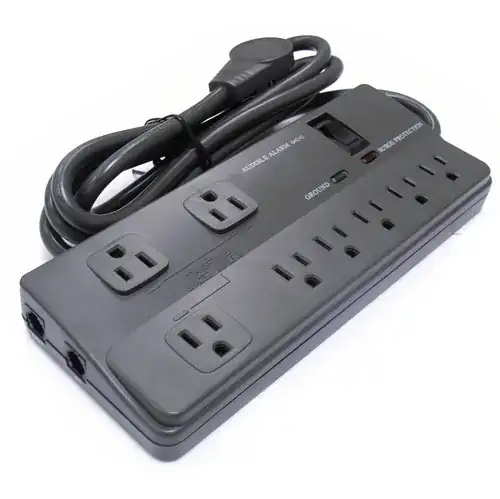
(As per comments below, I've added a picture of a good power bar to my answer here...)
enter image description here

Randolf Richardson
  • 14,634
  • 39
  • 52
  • 2
    Is a surge when the power goes off, or when my house gets hit? – Simon Sheehan May 23 '11 at 23:59
  • 3
    A surge is when the power goes higher than it's expected to. A drop is when the power falls below what it's expected to. When the power goes out, it's not uncommon for a small surge to occur, but when it comes back on then stronger surges are more common. – Randolf Richardson May 24 '11 at 00:00
  • 3
    If things are properly grounded, then the damage should be minimal-to-none. If your house gets hit by lightning, you should inspect it as soon as the storm passes and if you have any doubts just call the local fire department (local non-emergency numbers should be in the phone book) and ask them if there's anything you should check for (fire fighters are always glad to help someone who wants to prevent problems, especially for serious situations such as where lightning strikes a house). – Randolf Richardson May 24 '11 at 00:04
  • 1
    I know my parents have left it on before in such cases. Does it accumulate over time or anything? – Simon Sheehan May 24 '11 at 00:06
  • 5
    Each surge is different, but damage can occur incrementally. Light switches made with aluminum wiring are perfect examples of one such type of damage (with each use, the aluminum contact points melted a little bit, eventually to the point of a gap forming that caused sparks which, in many cases, started house fires from inside the walls). Computers have a lot of surge protection mechanisms, but protecting those mechanisms is certainly a good practice. Chances are your power supply will be what gets damaged the most, as it takes the brunt of the surges, but some surges can go beyond this. – Randolf Richardson May 24 '11 at 00:13
  • 2
    Okay, thanks for the info. I may look into some surge protection or a UPS – Simon Sheehan May 24 '11 at 00:18
  • 1
    Most power bars have a little indicator light that shows if there is a problem or if you are protected (or it's not lit when there's a problem) -- it's confusing because there's no consistency among vendors. The best power bar I've found makes a noise when surge protection fails (and it also indicates if grounding is wired correctly, which is extremely important), which is crystal clear because everyone knows something's wrong when there's an audible alarm. I'll add a picture of one of these power bars to my answer in a minute or so. – Randolf Richardson May 24 '11 at 00:21
  • 3
    Power *strip*. This is a [power bar](http://i.imgur.com/xzT0L.jpg). – hyperslug May 24 '11 at 00:38
  • 1
    @hyperslug: I'd love to give you a "humour" badge for that (please don't elaborate on "power strip"), but I can't because there is no such badge -- http://meta.superuser.com/questions/2583/humour-badges – Randolf Richardson May 24 '11 at 00:42
  • 2
    @Simon: get a *decent* power strip. I had a cheap one to which the monitor was connected. When there was a surge the strip was fine, but there was white smoke leaving the monitor. – André Paramés May 24 '11 at 14:38
  • 1
    I'm seeing faces in the power bar, it is getting late... – Tamara Wijsman May 28 '11 at 01:40
  • @Tom Wijsman: They'll still be there in the morning (I suspect the two-pronged ones just wearing burkas). =D – Randolf Richardson May 28 '11 at 15:17
12

You're probably not going to find a surge protector that can stop a direct lightning strike. A lightning strike is anywhere from 1,000 to 100,000 Amperes with rise times measured in microseconds. Too high and fast for most/all surge protectors, and that's why many people suggest unplugging.

Since lightning strikes are rare (especially direct strikes) a standard UPS with decent surge protection is going to protect you against lesser (more common) surges, and is definitely worth having.

In the end I think it's choice and risk mitigation. If you have home insurance that would probably affect your choice (insurance will replace the hardware anyway), and you can mitigate your data loss risks by having backups, etc.

Check out this article, it's got lots of good 'lightning vs. computer' information.

Ƭᴇcʜιᴇ007
  • 111,883
  • 19
  • 201
  • 268
  • 1
    A direct strike of lightning won't "follow" cables anyway; it has it's own strange rules. Also not that most "surge protectors" are only effective when being combined with a circuit breaker, as most work this way: A "varistor" creates a temporary shortcut when overvoltage is detected. It can stand a short time of hight current, but then the fuse should blow. Some devices may even be permanently damaged by design if overvoltage was detected. – U. Windl Feb 01 '23 at 07:33
8

Certainly @Randolf Richardson provided a good answer, but i'd like to add that disconnecting all connections that come in from outside is good practice. This means coax, DSL, etc. in addition to your AC lines. That's not to say i always do this, but that's why i've had modems and Ethernet cards fried.

  1. Shut it down.
  2. Pull the main power strip plugs from the wall
  3. Disconnect coax from the cable company or DSL from the phone company.
  4. Now go do the same for your TVs etc.

Even with your surge-protecting powerstrip or a UPS, you could still benefit from disconnecting during a storm; a direct or near-direct lightning strike could blow through your consumer UPS pretty easily.

(On a related note, if you know a bad storm is coming, make sure laptops, phones, camera, extra batteries, etc. are all charged.)

b w
  • 2,684
  • 4
  • 28
  • 33
  • Good idea--I just had my onboard NIC get fried somehow during a thunderstorm when power went in and out – nvuono Aug 15 '12 at 22:16