2

I'm seeing more and more of these screws (pictured below), which are almost triangular. I find I can only put them into Power Supplies and PCI(e) cards in cases, but they will break/strip away if I put them into a hard drive or a standoff for a motherboard
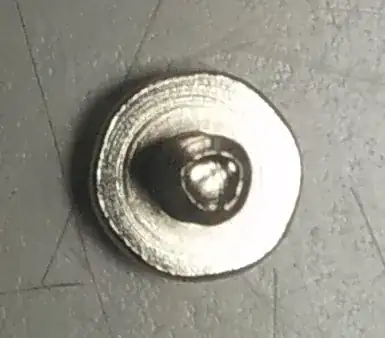
enter image description here

Notice the triangular shape on it? On the Root Access chat, I started asking, but no concrete answer yet. I don't assume it's a production flaw, as I've seen hundreds and replaced them with the "proper" round screws. It is coarse-threaded, not fine-threaded (i.e. for a DVD drive or floppy drive). What are they for, and why do we need them instead of the regular round ones?

Fopedush
  • 2,002
  • 5
  • 20
  • 36
Canadian Luke
  • 24,199
  • 39
  • 117
  • 171
  • 2
    It's spelled "coarse" not "course". The word means "rough", "not precise". You seem to have a batch of some low-quality coarse-thread screws. Thread pitch is not an indicator of quality, although I'd rather see machine screws used than self-tapping screws. – sawdust Dec 08 '12 at 00:53
  • Where exactly are you seeing these? – David Schwartz Dec 08 '12 at 01:09
  • on lots of computers, @David. I just pulled a bunch out of some motherboard stand offs – Canadian Luke Dec 08 '12 at 04:41

3 Answers3

3

The screw has a triangular cross-section to the threads because that's a technique used for many "self-tapping" screws. They are designed to be driven into an unthreaded hole and form a thread as they are driven -- the shape helps "form" the threads vs just cutting them.

They may occur with any thread pitch, but generally the shorter ones will have a relatively coarse thread, since they'd designed to be driven rapidly (with a power screwdriver on an assembly line) into sheet-metal.

Daniel R Hicks
  • 6,143
  • 3
  • 27
  • 50
  • I could definitely understand them being used in a factory. It'd have to be relatively accurate, as in my experience I found that using the ones I ran across with a power driver easily resulted in over-spun holes due to the lack of threads just under the head. It's like they have 'just enough' threads to hold two pieces of sheet metal together. It sucks when they're supplied as the only course threaded screws for use in pre-threaded holes. – Ƭᴇcʜιᴇ007 Dec 08 '12 at 05:59
  • @techie007 - Yeah, they shouldn't generally be supplied (at least not the short ones) for pre-threaded holes. And when used outside of a factory setting you need to use a hand nut-driver that will drive them square and not over-drive (just get them snug). If they don't seem to fit the threads I'd suggest finding screws that do. – Daniel R Hicks Dec 08 '12 at 13:57
2

I've seen tons of these over the years building computers, they are often shipped as chassis screws (for panels, power supplies, expansion slot cover plates, etc.)

And you're right, using them in a hard drive can wreck the threads pretty well if it's slightly out of alignment when screwed in, but based on the ones I've seen supplied with computer chassis they are the right/same threading.

Basically they work well (enough) for sheet metal fastening but for softer metals like aluminum you're better off using more precise, round-shafted screws.

The shaft shape is basically a Reuleaux triangle ('The shape, other than a circle, a manhole cover be made so that it cannot fall down through the hole').

As @sawdust points out in his comment, and now @DanielRHicks in his answer, they appear to be self-tapping screws intended for machine/assembly line usage.

I've personally used them as a substitute, ghetto tap because I felt they we're cheap, we usually had buckets of screws around the shop, and I'd rather destroy them instead of better screws (which would be used to finally fasten whatever I was making the hole for). :)

Ƭᴇcʜιᴇ007
  • 111,883
  • 19
  • 201
  • 268
  • The "less material" argument is BS. They're self-threading (as opposed to "self-tapping") -- they "form" threads rather than "cutting" them, a superior technique for sheet metal. – Daniel R Hicks Dec 08 '12 at 14:00
  • @DanielRHicks Yeah, I think it's probably BS as well, that's why I said "I believe"" instead of "It's because" ;) But I wouldn't be surprised that when faced with picking between screws to purchase for sending to the end-user, someone is choosing those because they're cheaper by the dozen and 'good enough'. Perhaps I'll update my answer regarding that. – Ƭᴇcʜιᴇ007 Dec 08 '12 at 20:47
1

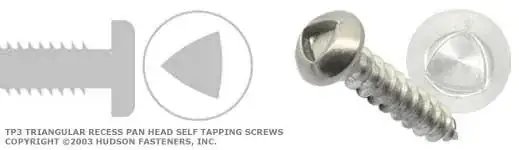
Looks like a TP3 style screw head (rounded triangle) and looks to have seen better days.

It is a type of proprietary/security screw head to keep the common folk from removing them. With the proper driver they are much like any other screw. Commonly see on Nintendo, Gameboy; Fast Food promotional toys and video games; Die-cast toys; Roomba battery packs (ref: Wikipedia)

TP3 TRIANGULAR RECESS PAN HEAD SELF TAPPING SCREWS

Image from www.hudsonfasteners.com which also offers a TP3 bit.

Brian
  • 8,896
  • 23
  • 37
  • 2
    I believe he's talking about the shape of the shaft (the bit the thread is on), not the shape of the head. – Bob Dec 08 '12 at 02:37