4

For example, if you have a 4TB hard drive with one solid 4TB disk (which I do not believe exists yet but that is besides the point), and you have another 4TB hard drive with 4 discs, does the one with 4 discs have a greater chance of failure?

How about 2 platters vs 3 platters? 10 platters? etc.

Update: Now that I know so much more 8 years later, my experience would be that platter numbers isn't as important as other factors like manufacturer and the type of drive. An enterprise-grade drive with 10 platters for example is less likely to fail than a consumer-grade drive with much fewer platters with brand who is known to have a high failure rate.

But it would be nice to see an apples-to-apples comparison, for example, few vs many platters drive from the same manufacturer in the same Enterprise hard drive line and the same technology (e.g. both either CMR or SMR), and both under the exact same loads (same datacenter, same type of server, same temperatures, same humidity, same usage case) to see if the quantity of platters is directly correlated to higher failure.

superuser
  • 3,428
  • 7
  • 25
  • 40
  • The maximum platters on a 3.5" is 5. – X.LINK Oct 02 '14 at 23:56
  • false; quote "WD says the first helium filled hard drives will feature a 7-platter design" - google search – superuser Oct 02 '14 at 23:58
  • At a regular height ? Not like the first 2.5" 1TB drives ? Damn, I'm getting old ^^" Anyway, I don't like those helium drives, they are more sensible to heat because of this gas. We don't even know how they will behave on long-term. – X.LINK Oct 03 '14 at 00:05
  • yep :) . . . . . – superuser Oct 03 '14 at 00:06
  • 1
    The problem is that a 1-platter drive and a 4-platter drive, with the same capacity, would have entirely different technologies. Apples to oranges. – Daniel R Hicks Oct 03 '14 at 11:44
  • x.link above said "The maximum platters on a 3.5in is 5", well now 8 years later it's not only 7, but many more, WD's new 22TB & 26TB drives will have 10 platters! https://images.anandtech.com/doci/17377/ten-disk-cut_575px.png What a marvelous work of engineering. – superuser Jun 02 '22 at 02:45

3 Answers3

4

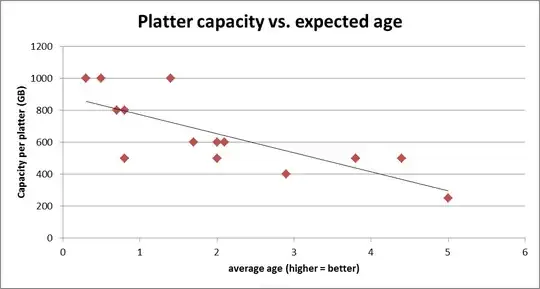
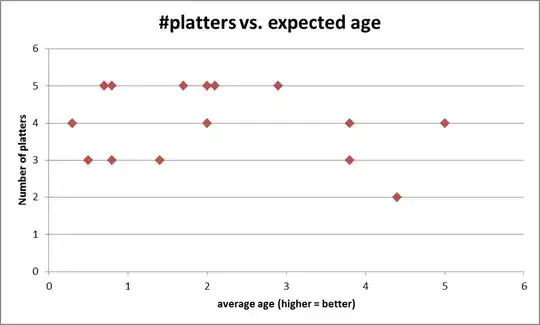
Backblaze published one of the biggest real-life studies to life expactancies of hdd´s. I looked up the number of platters and the platter capacity for each of the hdd´s they tested (data in Excel format here). I tested the number of platters vs. age and the capacity per platter vs age. Here are the graphs:

Number of hdd platters vs. expected age

Hdd platter capacity vs. age

My conclusion, (without further statistical testing or conditional probability analysis) is that the number of platters isn't really much of an issue (in this test pupulation), but the platter capacity is. You are better off (in terms of expected age) with more platters and less capacity per platter.

agtoever
  • 6,262
  • 1
  • 24
  • 37
  • Just noticed [Backblaze updated their data](https://www.backblaze.com/blog/hard-drive-reliability-update-september-2014/) which is **not** incorporated in these numbers. – agtoever Oct 03 '14 at 11:22
  • I don't know how they got these results, but two WD Caviar Green EARS 2TB bought at diffent places and time went down. They were the one with 5 platters, in comparison and in the same conditions, the EZRX with only two platters are still here. I mean, if they are comparing Caviar Blacks and Caviar Green, it's normal to have such results. Blacks have a far more better quality than Greens. While the Greens usually have more platters and density than Blacks, they are the first one to reach the biggest capacity. – X.LINK Oct 03 '14 at 13:47
  • I agree that the black and green series are a very different league. But even if you take the green's out, the pattern remains the same. I honestly don't know why Backblaze uses green drives (good question, though). But with all due respect, I think your n=2 experience can't beat Backblaze's n=26.556 experience. So I don't understand your downvote of my answer... – agtoever Oct 03 '14 at 14:23
  • Excellent answer. Thanks for the awesome graphs! – superuser Oct 11 '14 at 18:53
2

Having less platter means less mechanized parts, so less chance of failure. Consequently it also means less heat and also failure. But the problem is that if you got a failure on a whole platter, you will lose everything.

On the other side, a single platter means much more density, so do speed and access times.

I do personally prefer one platter since it's faster, lighter, but also less failure due to less mechanized parts. I mean, the more you have, the more it will be harder for the heads to spin correctly on the right cylinder, so the more it will easily be aged.

X.LINK
  • 2,291
  • 5
  • 23
  • 33
  • Practically speaking, if a single platter in a multi-platter HD fails, you won't be able to access the rest anyway. – ChrisInEdmonton Oct 02 '14 at 23:59
  • Well, it depends on a lot of factors, if the datas were contiguous or not, on the same platter, etc. Physical data recovery where replacing failing platters is possible, for a price... – X.LINK Oct 03 '14 at 00:02
  • Yeah my wrong i deleted my answer. I Misunderstood the question sorry. – Devian Oct 03 '14 at 00:05
2

Technically, the parameter of interest should be the number of read/write heads rather than the number of platters.
Typically there would be one R/W head per platter surface. A platter has two surfaces, so if both surfaces are used for data storage, then the number of R/W heads is double the number of platters (for the typical case).
I haven't opened up a HDD in a long time, but in the past I have seen HDDs built with unused surfaces and/or platters. Presumably these were platters that had only one "good" side and installed in a low-capacity model that was otherwise identical to a high-capacity model.

Increasing the number of R/W heads in a HDD is considered a performance benefit, since more data would be in each cylinder and thus can reduce seeks.
The typical tradeoffs for more R/W heads is added cost and reduced reliability (added electronics, more mass to the head actuator) and increased susceptibility to a head crash.

if you have a 4TB hard drive with one solid 4TB disk and you have another 4TB hard drive with 4 discs, does the one with 4 discs have a greater chance of failure?

I would consider a 2-head (single platter) drive to have less chance of failure than a 8-head (4 platter) drive. But (assuming similar areal densities) the 8-head drive should have better random access times.

How about 2 platters vs 3 platters?

Until someone quantifies the increased risk of failure due to the number of R/W heads, you shouldn't base reliability and/or a purchase decision solely on the number of platters and/or R/W heads.

sawdust
  • 17,383
  • 2
  • 36
  • 47
  • Having more platters should theorically improve performance, it is not since the heads cannot move independently. Furthermore, if the data is placed on the same platter, it doesn't even means something. On the other side, one platters shortens access times since the density of bit per square make bits much more closer to access between each others. This just look like the problem between PATA and SATA. – X.LINK Oct 03 '14 at 01:16
  • "the 8-head drive should have better random access times" It won't since it is not possible, for the same capacity to have the same density for different platter number. "you shouldn't base reliability and/or a purchase decision solely on the number of platters and/or R/W heads.": I do prefer WD since not even one of them failed me, instead of Seagate, Hitachi and Fujitsu. You know that quality cannot be quantified exactly, but I can assure that WDs are the only one who park their heads when powered off, meaning much less head failures. And guess what, they are even really good on density. ;) – X.LINK Oct 03 '14 at 01:29
  • @user3755746 -- FYI I have first-hand experience developing firmware for disk controller and disk device drivers for various OSes. More heads is not a "theoretical" performance benefit; it's real. But increasing the areal density can provide a similar performance benefit, since that can increase the amount of data per cylinder. You are ignoring my stipulation of *"similar areal densities"*. – sawdust Oct 03 '14 at 01:38
  • 1
    Someone like you should even not have any doubts about the "8-head drive should have better random access times". To be even worse, if datas are scattered into multiple platters, meaning not the same cylinder on every level, how even on earth can this be more faster than datas stored on a single and continuous segment of the same platter ? Heads just have to wiggle so much more since they all move at the same time !!! – X.LINK Oct 03 '14 at 01:46
  • @user3755746 - *"a single and continuous segment of the same platter"* -- That sounds a bit like the misconception mentioned in http://superuser.com/questions/432318/what-are-disk-sectors-for – sawdust Oct 03 '14 at 01:59
  • I meant a group of sectors that make a single and continuous segment on the same platter. Which is more likely to happens with a single platter. Consider no1 the number of platter and no2 the position on this platter: [1][4],[1][20],[1][40] are faster to reach than [1][3],[2][10],[3][25] because of density. And no1 case is more likely to be [1][4],[1][20],[1][40] than no2 to become [1][3],[2][33],[3][75], since less platters means less scattered bits on a lot of platters. Moreover, if world would be so perfect, we would have [1][5],[2][5],[3][5] but can't because of bit that are already here. – X.LINK Oct 03 '14 at 02:10
  • If you find a single-platter HDD that outperforms a multi-platter HHD, it's not because of the single platter. Other attributes (e.g. areal density and sectors per track, voice-coil actuator, spindle speed) had be be enhanced to achieve that level of performance in spite of that single platter. Your example is not clear and contrived. It has cherry-picked values, and therefore fraudulent. Increasing the number of heads and areal density in order to increase sectors per cylinder are known methods to improve performance. Using a single platter is an economy move marketed as a benefit. – sawdust Oct 03 '14 at 04:42