2

I've recently had to benchmark the CPU performance of a variety of operating systems on identical machines. I've been using the 'benchmark' functionality of Prime95 to obtain a consistent test. I've gotten some unexpected results such as Windows 2012 performing significantly worse than Windows 2008. It's prmpted me to wonder what Prime95 tests actually do and what I can infer from my results.

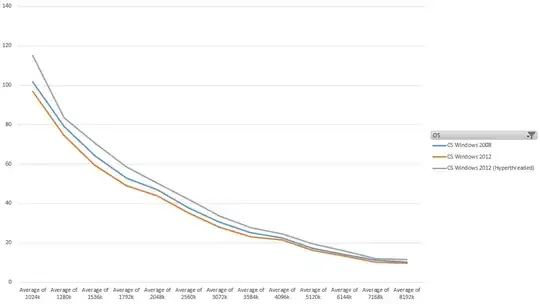
There appear to be two distinct phases to the test. Phase one appears to use one of what Prime95 calls a "Worker" but does so using a various numbers of threads. Looking at activity on my CPU I can see that each core is being used fairly evenly. Here's a graph:
CPU benchmarking with Prime95

The orange line is a normal Windows 2012 machine and the blue line Windows 2008. The grey line is Windows 2012 with hyperthreading enabled. As you can see Windows 2012 tails off significantly as the tests become more intensive.

Phase two appears to be the same as phase one except for the the idea that it benchmarks "multiple workers to measure the impact of memory bandwidth." Here's the corresponding graph for this test:
Multiple Workers benchmark with Prime95

Phase two, however, doesn't quite marry with the results from phase one; Windows 2012 doesn't tail off as it did before and the hyperthreaded install is better even than Windows 2008.

My question is, what operations is the Prime95 benchmarking tool undertaking and what sort of factors might come into play to deliver the results I'm seeing?

deau
  • 164
  • 5
  • My understandig is that all prime95 does is a series of multiplikations calculating prime numbers in the form of (2^n)-1 using the lucas-lehmer-test. But this isn't what you were looking for, is it? – ap0 Oct 08 '14 at 14:46
  • what version are you running? what are you running it in and on? The worker window for the benchmark operation shows what it is doing at the time, various test/sizes with varied multithreading (1-?? cores). – Psycogeek Oct 08 '14 at 15:14
  • @Psycogeek I'm running the latest version for 64bit machines on a variety of OSes. I realize what the program says it is doing. I'm wondering what this is testing. What does a machines ability to do this test faster/slower reveal about that machine? – deau Oct 09 '14 at 10:49
  • @ap0 yes, ty but you're quite right; I'm wondering what I'm testing and what factors might go into a result. It's fine and dandy getting a benchmark but until I understand the factors that go into it I'm unable to positively respond to results without resorting to trial and error. – deau Oct 09 '14 at 10:51
  • math, the speed at which the processor can do a specific math routine http://mersennewiki.org/index.php/Fast_Fourier_Transform http://mersennewiki.org/index.php/Lucas-Lehmer_Test While most of it looks integer, there is an understanding that it uses the FPU co-processing aspect of the cpus. Maybe you can understand the mathamatics of it? – Psycogeek Oct 09 '14 at 12:03
  • @psycogeek Yes, i can appreciate The mathematics involved. As such phase one of the test is fairly simple: how quickly can you compute lots of stuff? Phase two, however, purports to use multiple workers to benchmark memory throughput. Something else is apparently going on there... – deau Oct 09 '14 at 15:14
  • i do not understand the math process, so I cant understand how they can use all the memory doing it at all. like the torture test can be set for both test size and memory use (all of available if desired) . If you needed memory thouroput/througput , and cpu speed, and fpu speed or even office type speed or game type speed benches, all of those exist, and more that can concentrate on more specific things, beyond prime. – Psycogeek Oct 09 '14 at 16:35
  • It's more likely that you've run into 2012's more aggressive power saving. Check your Ghz – Patrick Dec 18 '18 at 23:56

0 Answers0